

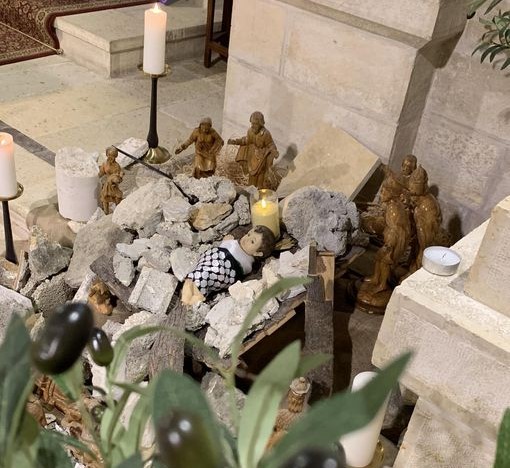
 Mother of four, Um Bishara, went to her local church to see the nativity scene. She was taken aback by what she saw. The baby Jesus Christ was the central figure, but he was lying, not on a bed of straw, but on a bed of rubble.
This nativity scene is in the Lutheran Christmas Church, Bethlehem, in the West Bank, and reflects the reality of children born in nearby Gaza, some of whom are being born in the rubble: others are dying there.
When the significance of the display hit her, according to a local news report, Um Bishara sat down and wept.
The dreadful events that have been taking place in today’s Israel and Palestine are not so different from the time that Jesus Christ was born. The country was in political turmoil: it was occupied by Rome and children were slaughtered. Despite all this, a love story was unfolding. It was the story of God’s love for God’s creation. In the middle of the world’s noise and trauma, a message of peace and love was seen and heard as Jesus Christ, the embodiment of God’s love, was born. Paradoxically, being born in traumatic and unwelcoming circumstances brought hope and joy, showing that no depth of darkness can ultimately overwhelm or obliterate love.
Today’s nativity scene in Bethlehem, put together by people close to the horrors that have been taking place, is a sign of hope and a recognition that God’s love cannot be overwhelmed or obliterated by darkness and destruction. This is as true for us in our lives as it is for the people of Israel and Palestine. This is what is celebrated at Christmas. God’s love is ours if we want it.
The Christmas carol ‘It came upon the midnight clear’ speaks particularly powerfully today in these words:
Yet with the woes of sin and strife
The world has suffered long;
Beneath the angel strain have rolled
Two thousand years of wrong;
And man, at war with man, hears not
The love-song which they bring;
Oh, hush the noise, ye men of strife
And hear the angels sing.
May this Christmas make us all more aware of God’s love which cannot be overwhelmed by darkness and destruction and may our prayers be for peace and justice in the lands where Jesus lived and walked.
 Bishop Brian Castle
Thanks for the Read !!!!
take care
Thanks – you take care too.,
I wonder how many of us who have sung for many years the words of the traditional Christmas songs have this year found in them a renewed meaning, both disturbing and comforting.
I agree. When it was written in 1850 by American Unitarian Edmund Hamilton Sears the author could not have imagined how much it would speak in 2023. A good hymn ‘flies’ and has a universality about it,
Thank you for this article Brian. We all go on praying for peace in Gaza as well as Ukraine and so many other places in the world, and yet the killing goes on. I believe that wars and conflicts throughout the world ultimately are a thing which show the sin of the world in which we too are involved. Is not about sins, but about sin, and that sin is part of the make up of all of us. When we confess our sins, we are doing something helpful to the situation in Gaza. We must continue to pray constantly for peace.
I agree. We are all part of the sin of the world and need to seek forgiveness.
There is so much to ponder on in this Chritmas reflection. The photograph of the nativity scene so aptly allows us to glimpse the reality of what is happening in Gaza; amidst all the horror and pain of war, the loss of life and destruction of a city, that is on a scale it is impossible to imagine, babies are born. And in that misery the light of Christ is ignited and shines out through the compassion and tears of a lady called Um Bishara who is worshipping at a church in Bethlehem some 45 miles away.
I appreciate the thought Simonandy shared; that we are all part of the world’s sin and asking for forgiveness, perhaps within the Lord’s prayer, has a rippling effect that touches Gaza. And the light contines to shine in the darkness ——–