
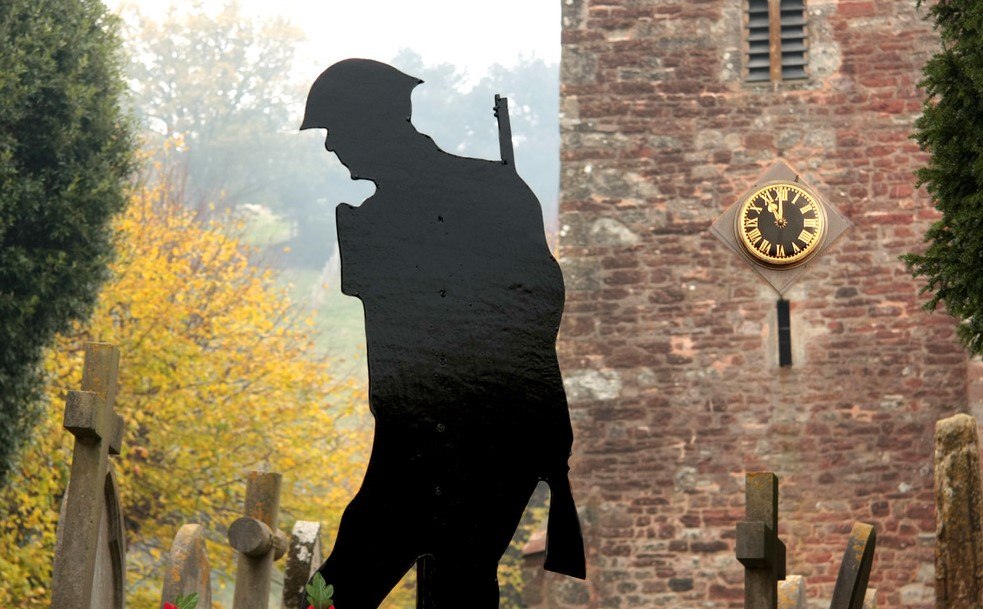

At the going down of the sun and in the morning, we will remember them.
We remember their valour, their courage and their sacrifice – but the way we remember is important. It can make the difference between trapping us in a spiral of violence on the one hand, or, on the other, offering hope for the future.
I cannot remember commemorating a Remembrance Sunday surrounded by the reality of wars so close that we can almost touch them: a war in Europe between Ukraine and Russia and a war in the Middle East in Israel and Palestine. In addition these wars have spilled over and affected our lives in this country: children attending Jewish schools are told not to wear the star of David so as not to risk being attacked; there has been a rise in Islamaphobia; we have welcomed many fleeing from the violence in Ukraine; in towns and cities over the last month there have been marches and demonstrations calling for a cease-fire in Palestine. We are watching close-up the enormous toll of war: people losing loved ones, losing house and home, and losing their future. We are witnessing the pain, sense of fragility and the deep trauma that men, women and especially young people and children are experiencing.
Such pain and trauma are the shared realities faced by all impacted by loss in war, regardless of nationality, rank, background, colour or creed. They were experienced as much in WW1, WW2, in Bosnia, Iraq and Afghanistan as they are today. These uncomfortable and immediate realities provide a lens through which we can look at today’s commemoration of remembering and honouring our heroes who were killed in conflict. Furthermore, and this is the paradox, in all this darkness there may be a glimmer of hope which will help us focus our commemoration today and tell us something about the way we remember. To begin, I want to tell you of a moving interview from last week which you may have seen.
 A distraught Israeli mother was speaking about her child. She had just learnt that her teenage daughter, who had been at the music festival attacked by Hamas, had been killed. The mother had seen a video of her lifeless body in the back of a pick-up being abused and spat on. The mother said she didn’t know what to think or do. She was totally disoriented. She knew that something had to be done about Hamas and she also said (and I quote) ‘many innocent civilians in Gaza shouldn’t suffer as they are.’ In the depths of her agony, the comments of this grieving mother facing the worst nightmare that any parent has to face contained seeds of hope: they are diamonds in the mud. Her recognition of the suffering of innocent Palestinians, many of whom were mothers, like her, also grieving the loss of their children, was remarkable, showing the heights to which the human spirit can soar. It showed a very human solidarity of suffering which leaps across the divides providing a bridge between people. These are seeds of hope.
Today, Remembrance Sunday, we join with thousands of communities across the country remembering with thanksgiving those in the armed services who have lost their lives and we remember the pain and distress caused by their deaths and suffered by their relatives and friends. We also pray that in remembering their sacrifice and the pain of their loved-ones, we, today, may work all the harder for peace, justice and reconciliation in places of conflict.
 In these acts of remembrance across the country, we will be remembering in different ways. Yes, we all share the fact that we are honouring heroes. The reading this morning reminds us of the words of Jesus Christ, ‘No one has greater love than this, to lay down one’s life for one’s friends.’ But there are also differences which can be seen in the way these sacrifices are viewed.
At the national remembrance in London, the emphasis is on justifying the conflict and the sacrifices which have been made on behalf of the nation, for the greater good. Those who have died are remembered in words inscribed on the cenotaph as the ‘glorious dead’ who sacrificed themselves in ‘a fight for the world’s freedom’ as inscribed on another nearby memorial.
But it is different in local communities like ours where remembering is much more personal. Yes, as on the national memorials, our heroes died ‘for king and country’ but then we are given their names. In Manchester, after the first world war, many streets had roles of honour with the names of those from the street who had died in the conflict. On the war memorial at Downham Market, Norfolk are the words: ‘All that we had we gave,/ All that was ours to give, [we] freely surrendered all/ that you in peace might live.’ Here at Wootton Courtenay, we have our war memorial with the names of locals, from families known to many. In the national memorials, those who fell in conflict died for the nation, but in the local places, in Downham Market, in Wootton Courtenay, they died for their families, and friends, for their communities. It is the families, friends and communities that bear the pain of losing young lives, losing part of their future.
 These are all legitimate ways of remembering, but what is really important is that as we become more distant from the conflict, more distant from those who fell, that we don’t romanticise war and that we keep in touch with the pain, horror and loss that their deaths brought to their families, friends and communities. If we asked those soldiers why they put their lives on the line, many would say it was to protect their mums and dads, their brothers and sisters, their wives and families. That was their first priority and in protecting their loved ones, they were also protecting the nation. It was their loved ones who bore the pain and loss, it was the loved ones whose humanity was being battered. Furthermore, what can unite human communities, especially communities in conflict with each other, what brings them in solidarity with one another, is not ethnic uniformity, it is not a vision of nationhood agreed by all parties, but rather it is the acknowledgement of shared pain, shared hurt and shared fragility, which, in the darkness, offers hope. It leaps across the divides offering us a common language. Recognising our shared humanity, that all share this same pain, can, if we allow our humanity to soar, be a seed of hope, a diamond in the mud which edges us towards peace and reconciliation.
At the going down of the sun and in the morning, we will remember them.
Let’s remember and give thanks for our fallen heroes in a way that allows our humanity to soar, in a way that brings hope.
Sermon preached at Wootton Courtenay
on 12.11.23.
Reading: John.15.9-17
Image 2: Kherson Hospital, Ukraine, after Russian shelling 2023
Image 3: Batou84 Wounded Palestinians awaiting treatment 2023
 Bishop Brian Castle
Yes, Brian, you rightly point out that we should never lose touch with the appalling physical realities of the events which in our formal acts of remembrance can be romantically distanced. Which is why, at the point at which we want to turn off the TV because we have “seen too much of the destruction and suffering” in Gaza and Israel we somehow owe it to the sufferers to keep looking.
Thanks, Keith. While we cannot ignore the suffering if we seek reconciliation, we need to be careful not to be overwhelmed by the media coverage of it which can distort our world-view and make us feel depressed. I would suggest limiting the times we watch /hear the news each day. for the sake of our mental health.
Specifically it’s better not go to sleep on the news or to wake up to it! Thanks for the reminder. K.
I agree with all you say Brian, and I particularly love the phrase ‘a diamond in the mud.’ Thank you for that. On the other hand, having served during the Balkan war in Kosovo in 2000, most of those soldiers really had no comprehension that what they were doing would in any way help to protect their families or friends back home. Further, I find it almost unbelievable that we apparently have the SAS in Afghanistan still, and are flying regular sorties to bomb targets in Syria, especially in in Idlib province. When will we try a better way of dealing with some of the problems of the poorer parts of the world than simply bombing them?
Thanks for your helpful comments . Your own service brings important insights. I agree that we never seem to learn and it’s often the poorest who suffer most. War is a failure of civilisation.
Thanks for your comments and observations. Thank you, too, for your service in the army. I agree that we find it difficult to learn from past mistakes.