

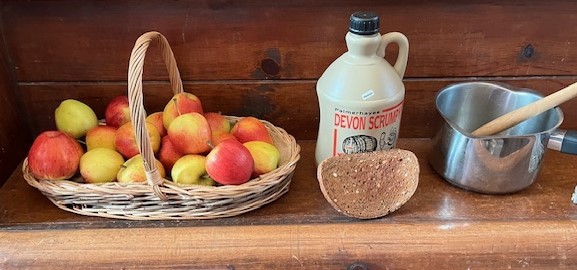
 What do apples, cider, a robin, toast dipped in cider, a pan and spoon have to do with wassailing? I’ll come back to that in a few minutes.
What exactly is wassailing? What does it mean? Why is there so much interest in it, not just locally but across the world? How does this ancient ceremony traditionally conducted by candle-light speak into our digital age?
‘Wassail’ comes from an Anglo-Saxon word which means ‘Good Health.’ Over the centuries both people and trees have been wassailed. To wassail people or trees to wish them well so that they flourish. Nobody knows for sure, but the roots of wassailing may go back at least 1500 years.
 There are, then, two traditions of wassailing: one where the focus is on people and the other where the focus is on trees. I will say a little about the first but a bit more about the second. The first took place before Christmas and the second after Christmas, around twelfth night.
The pre-Christmas wassailing tradition focused on people. It was a form of carol singing with a difference–the Somerset Wassail was sung at the pre-Christmas wassailing. The poorer people of a village would put on their Sunday best and call at the houses of the better off and appeal to their Christian charity, asking for some Christmas cheer in the form of warmth, food and drink. In return they would wish good health (wassail) to their wealthier neighbours –words in the Somerset Wassail Song say it all:
For it’s your wassail and it’s our wassail
And it’s joy be to you and a jolly wassail
Oh master and missus, are you all within?
Pray open the door and let us come in
O master and missus a-sitting by the fire
Pray think upon us poor travellers, a travelling in the mire
Oh where is the maid with the silver-headed pin
To open the door and let us come in?
Oh master and missus, it is our desire
A good loaf and cheese and a toast by the fire
There was an old man and he had an old cow
And how for to keep her he didn’t know how.
He built up a barn for to keep his cow warm
And a drop or two of cider will do us no harm
On occasion there was a strong expectation, almost a demand, that refreshment would be supplied – the wassailers could be a bit intimidating. One song that turned a request into a demand was: ‘We wish you a merry Christmas’ with the words ‘We all want some figgy pudding, so bring some right here…..And we won’t go until we get some.’ Perhaps the more cider that was drunk, the more insistent the singers became.
The other Wassail tradition – and here come the apples, cider, robins, toast dipped in cider, pan and spoon – happened after Christmas and they took place in regions such as ours in west Somerset. It was a wassailing, not of people, but of apple trees. Effectively, the community was asking God’s blessing on the trees so that there could be a fruitful harvest. This took place around twelfth night which marked the end of Christmas celebrations and just as the farmers and agricultural workers were about to return to work after their Christmas break. Soon after the Wassail there was plough Monday when the ploughs were all blessed as they were about to be worked in the fields: that’s another story for another day, but it all shows how the church, the rural economy and the agricultural year were closely linked.
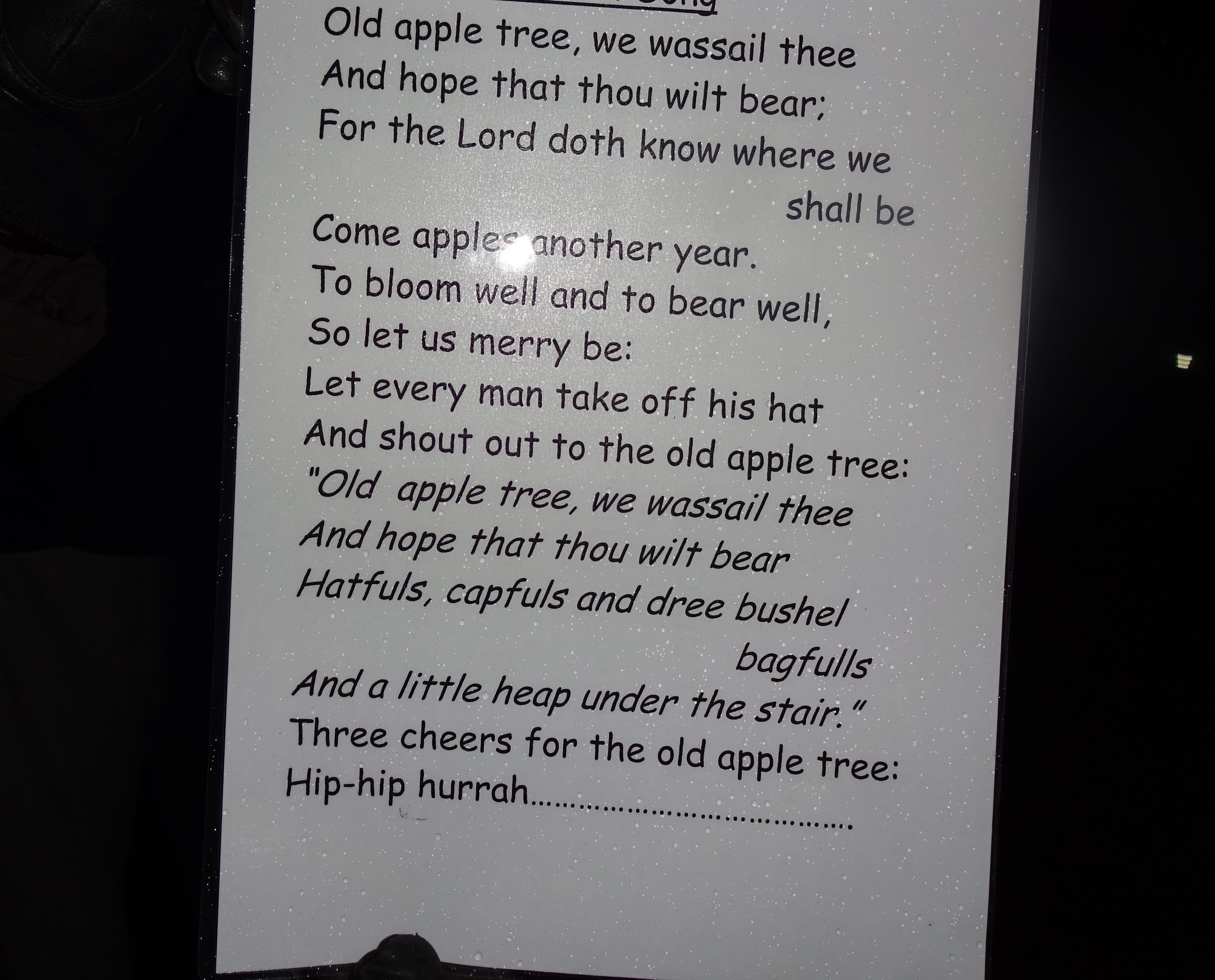 Returning to the Wassail ceremony, this is what happened. Villagers, led by a Wassail Queen, would go to the oldest tree in the orchard which had been decorated, a bit like a Christmas tree, and they would pour cider, made from the previous year’s apple crop, around its roots. The Wassail Queen would hang toast, soaked in cider, on its branches. Then the leader of the ceremony would wassail the tree wishing the tree good health for the coming year and asking for God’s blessing to produce a good crop – words reproduced above. After that a great racket is made, shouting, whistling, banging of pots and pans and sometimes gun fire. If you attend the wassail ceremony in nearby Porlock, it is the pans and shouting that make the racket. If you go to the ceremony in Carhampton, which takes place on 17th January (next Friday – 12th night in the old calendar) the farmers fire off their shotguns at this point. The reason for all this noise is two-fold, first to frighten off the evil spirits which could blight the trees and secondly to wake the tree up after its winter sleep. Then there will be story-telling and singing, food and drink – cider, of course.
 Now this may sound a quaint ancient ceremony which speaks of a bygone age when local communities depended upon apples for their economy. But at its heart is something much more universal. It is a ceremony that digs into our spiritual and cultural psyche and touches on something as relevant today as it has been through the history of humanity, that is the battle between good and evil. The evil spirits, enemies of the tree, were supposed to be frightened off by the loud noise. The toast, soaked in cider, gave a more practical dimension to this battle. The toast was used to attract birds, particularly robins, who gorge themselves on the bugs that bring disease to the tree and its fruit. Hence wassailing has become a ceremony that keeps the apple crop healthy and at the same time reminds the community of the universal battle between good and evil. Also, it would not have been lost on our forebears that the ceremony takes place close to the winter solstice when darkness gives way to light. In the Porlock celebration, the struggle between good and evil is highlighted in the mummers’ play which is enacted before the wassail: a mummers’ play is a raucous pantomime depicting the battle between St. George and the dragon……the quintessential battle between good and evil. Put together, the ceremony is a fun evening for the community which touches upon some profound themes in human culture and spirituality.
As I said earlier, it is not simply a ceremony that takes place in the west country. When Jane and I attended the Porlock Wassail some time ago, we met a couple who were visitors to the area. They told us they also held wassail ceremonies in their home of Tasmania. The fact that wassailing takes place around the world indicates how this ancient ceremony touches universal concerns that affect us all. I conclude by highlighting three of them.
First, wassailing brings a community together. It is a community celebration in which people of belief and people of no belief can confidently join. Some people express concern that it is a pagan ritual. I don’t believe it is. Like many Christian celebrations, it may have pre-christian influences, but the fight between good and evil, the story of St. George and the dragon, the blessing of the apple tree wishing it good health all lie at the heart of faith.
Secondly, wassail ceremonies reveal a warm, even tender, relationship of mutuality with creation. The apple tree is serenaded and treated with respect. Even at a time when foods could easily be bought from the local supermarket, the ceremony reminds the community that its well-being depends upon the fruit of the land and these need to be cherished and respected for our own well-being. As society is becoming more aware of the potential for climate disaster (and currently we are witnessing dreadful fires in California) and recognises the need to change its relationship with creation, wassail ceremonies are embodiments of a different way of relating to our world where we can show respect or even love to nature.
Finally, community celebrations like the wassail can be enjoyable and fun while engaging with such important and weighty matters as the struggle between good and evil and our relationship with nature. I suspect this kind of engagement will help us take these matters seriously and even act upon them.
For it’s your wassail and it’s our wassail
And it’s joy be to you and a jolly wassail.
Reflection given at Songs of Praise Service, All Saints’, Wootton Courtenay, Exmoor, Somerset.
 Bishop Brian Castle